Leanne Benjamin & Errol Pickford in the Royal Ballet's Sleeping Beauty
Plot
[Excerpt taken from dance.about.com] As the ballet begins, baby Princess Aurora is being christened. A wicked fairy, Carabosse, storms in and curses the baby, as her invitation to the event had been overlooked. The curse states that on her 18th birthday, the princess will prick her finger and die. However, the Lilac Fairy weakens the curse. She proclaims that instead of dying, Princess Aurora will fall into a deep sleep for 100 years. She will then be awakened by the kiss of a handsome prince.
During Aurora's 16th birthday party, a mysterious guest (Carabosse) offers her a gift...a lovely spindle. Aurora pricks her finger and the whole court falls into a deep sleep.
Several years later, the Lilac Fairy produces a vision of Aurora which Prince Desire notices while hunting. The Prince is led to the castle, where he battles the wicked fairy, Carabosse. After the battle, he kisses the sleeping princess, upon which everyone wakes up. A beautiful and joyous wedding ceremony follows.
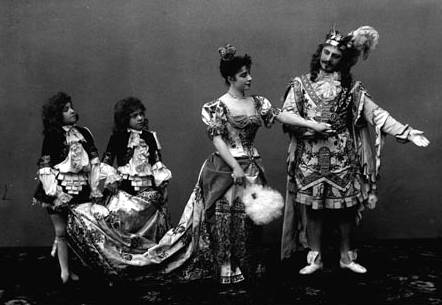
Photo: Carlotta Brianza and Paul Gerdt in the 1890 production of the Sleeping Beauty by the Mariinsky Theatre
Sleeping Beauty Trivia
Music composed by Tchaikovsky, and choreographed by Marius Petipa2
The premiere performance took place at the Mariinsky Theatre in St. Petersburg, Russia in 1890. The work is widely regarded as Tchaikovsky's finest ballet score, and has become one of the classical repertoire's most famous ballets.2
Tchaikovsky's three ballet scores include Sleeping Beauty, Swan Lake and The Nutcracker.2
Sleeping Beauty, or La Belle au Bois Dormant, is based upon the classic fairy tale from 1697 by Charles Perrault, Contes de ma Mère l'Oye ("Tales of Mother Goose")2
Aurora is one of the greatest and most challenging female roles, as it demands tremendous athletic ability as well as extremely clean technique.1
At the wedding, many other fairytale characters appear as wedding guests - Puss in Boots, the White Cat, Little Red Riding Hood and the Wolf, and even Cinderella.2
Nikkya's death scene - Paris Opera Ballet, 1992. Dancer: Isabelle Guerin
Watch the Paris Opera Ballet's Corps de Ballet perform the Kingdom of Shades scene (not able to embed it). You dancers out there will appreciate the extreme difficulty of executing arabesque fondues over and over again for an entire FIVE minutes! Talk about serious lower back cramps! Then, to go from that to perfect formations, gorgeous developpes, and more arabesques. Only the Paris Opera can make it look so perfect and flawless, and these aren't even the Etoiles!
Plot
This ballet, set in 19th century India, has all the makings of a juicy soap opera - an exotic dancer, a warrior, a love triangle, murder, drugs, revenge, ghosts, and true love.
La Bayadère (which means Temple Dancer or Temple Maiden) tells the story of the Bayadère Nikiya and the warrior Solor, who have sworn eternal fidelity to one another. The High Brahmin, or high temple priest, however, is also in love with Nikiya and learns of her relationship with Solor. Moreover, the Rajah Dugmanta of Golconda (or ruler) has selected Solor to be the fiancé of his daughter Gamzatti, and Nikiya, unaware of the arrangement, agrees to dance at the couple's betrothal celebrations.
The jealous High Brahmin—in an effort to have Solor killed and have Nikiya for himself—tells the Rajah that the warrior has already vowed love to the Bayadère over a sacred fire. But the High Brahmin's plan backfires when, rather than becoming angry with Solor, the Rajah vows that Nikiya should be the one who must die. Gamzatti, who has been eavesdropping on this exchange, summons Nikiya to the palace in an attempt to bribe the Bayadère into giving up her beloved. As their rivalry ensues, Nikiya picks up a dagger in a fit of rage and attempts to kill Gamzatti, only to be stopped in the nick of time by Gamzatti's aya (or maid). Nikiya then flees in horror at what she had almost done. As did her father, Gamzatti vows that the Bayadère must die.
At the betrothal celebrations Nikiya performs a somber dance while playing her veena (an Indian musical instrument). She is then given a basket of flowers which she believes are from Solor, and so begins a frenzied and joyous dance. Little does she know that the basket is from the Rajah and Gamzatti, who have concealed beneath the flowers a venomous snake. The Bayadère then holds the basket too close and the serpent charges forth and bites her on the neck. The High Brahmin offers Nikiya an antidote to the poison, but she chooses death rather than life without her beloved Solor.
In the next scene the depressed Solor smokes opium. In his dream-like euphoria he has a vision of Nikiya's shade (or spirit) in a nirvana among the star-lit mountain peaks of the Himalayas called The Kingdom of the Shades. Here, the lovers reconcile among the supreme opulence and order of the shades of other Bayadères (in the original production of 1877 this scene took place in an illuminated enchanted palace in the sky). When Solor awakes, preparations are underway for his wedding to Gamzatti.
In the temple where the wedding is to take place the shade of Nikiya haunts Solor during his dances with Gamzatti. When the High Brahmin joins the couple's hands in marriage, the Gods take revenge for Nikiya's murder by destroying the temple and all of its occupants.
The spirits of both Nikiya and Solor are reunited and spirited off toward the Himalayas.1
La Bayadère is an important connection between the romantic and classical eras of ballet, where the ballerinas wear the shorter classical tutus when doing ballet roles, but there are still many romantic movements and La Bayadère predates the major romantic classics by several years.2
Bayadère is French for an Indian temple dancer. In Russian it is called Bayaderka, the Russian word for an Indian Temple Dancer.2
The Kingdom of the Shades, the last scene from the ballet, is one of the most celebrated excerpts in all of classical ballet, and it is often extracted from the full-length work to be performed independently. It is also one of the most difficult men's variations that exist, with very large jumps including cabrioles and a beautiful manege (dancing in a circle) at the end.1
The Bronze Idol, (also called "Golden Idol" and "Little God"), is an incredibly demanding men's variation. Dressed only in a dance belt and headpiece, the dancer paints his entire body gold for this variation.2
Mikhail Baryishnikov performs Albrecht's variation from Act II with the Willis. Notice how he defies gravity!
Plot
Giselle is set in the Rhineland of France in the middle ages during the grape harvest. The story begins when Giselle falls in love with a nobleman named Albrecht, who has captured the girl’s attention while masquerading as a farmer named Loys. However, Hilarion, a hunter, is also in love with Giselle and warns her against trusting this stranger. When Giselle finds out that Loys is not only a liar, but is a liar with a fiancée, the young peasant girl with a weak heart dances herself to death and becomes one of the Wilis, the virgins who have been cheated out of their marriages by death.
Albrecht, who is still in love with Giselle, visits her grave and she appears as a ghost before him. He asks for her forgiveness, and against the will of the Willis, she grants it to him and disappears again. Hilarion enters the last scene, also to visit Giselle's grave, and then is thrown to his death in a lake by the Willis. The Willis then pursue Albrecht and sentence him to death, but Giselle protects him and her love saves him from the Willis. By not succumbing to feelings of vengeance and hatred that define the Wilis, Giselle is freed from any association with them, and returns to her grave to rest in peace.
Giselle Trivia
Jean Coralli and Jules Perrot choreographed the original version of Giselle, but the most popular version includes the revisions of Marius Petipa.
Originally performed in 1841 in Paris, France at the Ballet du Théâtre de l'Académie Royale de Musique
The ballet was conceived by the influential French poet, author, and critic Théophile Gautier.
Giselle was created to honor the ballerina Carlotta Grisi, an Italian ballerina, whom Gautier not only admired for her dancing, but with whom he was in love.
Gautier was inspired by a passage from Heinrich Heine's 1835 poem, De l'Allemagne