Thursday, May 13, 2010

Dancer Tips: Girl-Only Partnering


Let's face it, girls, most guys run from dance studios. They still haven't gotten the hint that it could be their best opportunity yet to meet some cute chicks! Many of you will never get to do a pas de deux with a guy in your regular dance studio, but there is good news! Choreographers have gotten creative with girl-only partnering, making girl-only dances much more dynamic and exciting. And it's not just about traditional lifts that guys do so well, it's also about just physically interacting with your partner - interlocking limbs, counterbalances, and supporting each other.

Dancer Jen Peters gave some girl-only partnering tips in Dance Spirit magazine. Check it out!

Who Needs Him Anyway?
A close look at all-girl partnering.
When you think of “partnering” do you imagine the romantic Romeo and Juliet or elegant Sugar Plum Fairy and Cavalier Prince? While you are definitely right in some instances, partnering can come in many forms. In essence, partnering is any moment when two or more dancers are supporting, lifting or tossing each other, whether they are two girls, two guys, one girl and two guys, one girl and one guy—you get the picture!

Today, even ballet companies have same-sex partnering in contemporary pieces, and some modern companies—like Urban Bush Women, Gina Gibney Dance, Lori Belilove and Company—don’t even have men. Knowing how to partner and be partnered by another girl is an important skill to develop, no matter what type of dancer you want to be. Read on for tips and advice about girl-only partnering from three NYC professionals: Samar Haddad King, artistic director of and dancer in Yaa Samar! Dance Theater; Maresa D’Amore Morrison, member of Urban Bush Women’s second company; and Helen Pickett, former Ballett Frankfurt (Forsythe) principal dancer, choreographer and modern partnering teacher at The Ailey School.


Emotional Differences
Before approaching the physical logistics of partnering another girl, it’s important to realize that you might feel strange about it due to your ingrained ideas about partnering—and that’s okay! Traditional male/female partnering fits into stereotyped gender roles, where the woman is light and delicate, and the man is strong and powerful. Fortunately, this is the 21st century, where girls can play soccer or cheerlead, be a science wiz or a homecoming queen. Same sex partnering melts the traditional mold into something cool and current, where girls can be strong and beautiful at once.

While the physical differences from all-girl to co-ed partnering are obvious, the emotional aspects are more hidden. If you are used to being lifted and twirled by a guy, partnering a girl may be an ego blow at first. There is a sense of equality: You have to be willing to let go of the spotlight and just dance. “If a dancer cannot let go of her ideas and listen to someone else, then partnering will not work,” says Pickett. Say one girl is doing a slow hinge to the floor while the other counterbalances her weight by holding her hand and leaning away. If the support person is overly concerned with how she looks in her moment, she can’t tune into her partner. The “hinger” may crash to floor if her partner isn’t 100 percent focused on her movements.

During the past year with Urban Bush Women, D’Amore-Morrison learned the importance of vulnerability and openness with her female partners. Communication is the key to problem solving, and blaming your partner for mistakes is not productive. “We are mature and intelligent as dancers, so we can talk to come up with solutions,” she explains. From King’s experience, sometimes an outside eye can find the answer to challenging partnering phrases. Just say, “I’m not understanding this part,” and you can work together to smooth out the moves.


Back to Basics
 Now that you’ve decided to go with the flow in terms of female/female partnering, you can tackle the physical aspects. Fortunately, most of the technique correlates with what you already know! Remember when you first learned to plié? It was the base of ballet class, and no surprise here, it is the base for partnering. “Use your legs, get into the floor and anchor yourself,” explains Pickett. If someone is jumping into your arms or leaning onto your body, you need to be even more grounded and secure. Imagine yourself as a tree: The deeper your roots go underground, the less likely you are to fall over. “Even among men, the common misunderstanding is to lift and support from the arms,” says King. “The strongest part of the body on anyone is the legs.”

This is apparent even in a classic shoulder/sit lift: If the man pliés as the woman jumps up, he only has to use his arms to guide her safely onto his shoulder, rather than hoisting her up like a weight at the gym. The same lift with two women requires exactly the same technique, but more power and a higher jump from the girl being lifted. The lifter should keep her stance strong and her core engaged to create a safe base for her partner.


Girl Power
Of course, partnering is not quite as simple as a deep plié. Building and maintaining strength is also essential. “You can’t just wish a lift is going to happen!” exclaims D’Amore-Morrison. “We do daily push-ups, theraband exercises and a lot of core work to keep our bodies safe and strong.” When being lifted, your core and arm strength play a key role in making you as light as possible.


Balancing Act
In class, we get used to dancing solo. So in the beginning, learning to partner another girl can be scary, awkward and uncomfortable. An easy way to start is holding hands while each person leans back, without falling. This is called sharing weight or counterbalancing. Play around with varying levels, add rotation and really see how far you can go off your center of gravity. During Yaa Samar! rehearsals, King asks her dancers to connect with different body parts—hooking elbows, locking legs—to see how the weight shifts between partners. “We disconnect from our partners, add in a turn and then reach for the other person to find a balance point again,” explains King.

Obviously, partnering requires dancers to get closer. You cannot be afraid to touch your partner, no matter how silly you may feel. In the early phases, partnering may be easier with a friend or familiar face, just to get past the uncomfortable stage. But even professionals laugh about partnering mishaps. Instead of letting it overwhelm the process, they get the giggles out and then get back to business! “When I dance by myself, I’m the driver of my own ship,” reveals D’Amore-Morrison. “With a partner, I have less control, which was hard to learn and requires more patience.”


Step Together
Open communication in rehearsal leads to an awesome partner-to-partner connection. Timing and breath are the final pieces in the partnering puzzle. If you breathe and feel each other’s rhythm, lifts and balances will meld seamlessly together and the two bodies can carve space together instead of alone. “Partnering is a conversation,” says Pickett, “not a monologue.”

As with any skill, the road to improvement requires practice. But this is the fun type of practice. Partnering with girls makes you a more versatile dancer and increases your strength. So grab a partner, and start your own dance conversation!

Jen Peters is a dancer with Jennifer Muller/The Works and is a frequent contributor to many dance publications.

 
Kristen Weiser and Harumi Terayama of Cedar Lake Contemporary Ballet performing French choreographer Angelin Preljocaj's "L'Annonciation," recounting the Christian tale of the angel who visits Mary.

Tuesday, May 11, 2010

New York City Ballet Workout

The New York City Ballet workout used to only be a book, then it was a DVD, and now it's available on YouTube for FREE! I always wanted to buy the book, but was too cheap, so I held off. Now that it's on YouTube, I've been doing the workout at home and was surprised by how much it got my heart rate up and felt like a great workout. I also taught it to my dancers in their ballet class - they liked it and were sweating, red-faced, and out of breath. For a teacher, that's success!

Here it starts with Part 1. There are 9 parts in all, and seems to be over an hour. Quite long, but I do the first couple of parts to get some cardio, stretch, and do abs. The voice-over is rather strange, but it makes it feel like you're in a ballet master class. See what you think!

Monday, May 10, 2010

Bun Heads - Tips for a Gorgeous Bun!

Do you sometimes get stuck in bun rut? Or would like tips from the pros on how they do a bun? Well, Annaheim Ballet in California has a great video on how to do a bun for long hair, short hair, and even African American hair. Check it out!

Dancer Tip: Focus on the Rib Cage

Paloma Herrera - notice how she looks very lifted and long, but her ribs are not splayed, or sticking out. The length is coming from her spine and back.

Last week we focused on the arms and explained how they are connected to the back and shoulders. But did you know the placement of your rib cage also affects your arms? Not only that, it affects your head, neck and even lower back, so paying close attention to your ribs and keeping them from sticking out is very important to your overall body placement. Check out this article from Dance Magazine to get tips to improve your rib placement!


Break Your Bad Habits: The Rib Cage by Lauren Kay

The placement of the rib cage affects the placement of everything around it: the head and neck, the arms, the lower back. Splaying open the ribs or letting them slouch—even if it feels comfortable—can throw off your line and make your movement more effortful than it needs to be. To help you kick those habits, Dance Magazine spoke with dance medicine practitioner Deborah Vogel; master Horton teacher Milton Myers; and Lupe Serrano, ballet teacher at the JKO School at American Ballet Theatre.

Habit: Splaying the ribs Dancers often pop the rib cage out and up to achieve extra height and presence. But this hyperextended position “appears stiff, tight, tense, haughty, and unattainable, though that’s often not the characterization the dancer wants,” Vogel says. Serrano agrees: “The problem starts with wanting to appear elegant and regal. But style should not interfere with the neutral position.” Myers adds that the lift can result from “trying to feel like you are up on top of the legs, but this distorts the rib cage—and the entire line of the body.”

Break it: Vogel says this problem is often more mental than physical. Many students have a limited awareness of the rib cage’s full three-dimensional range and its relationship to the breath. “The rib cage is like an umbrella,” she says. “When you inhale, the sides expand and the pole of the umbrella, or the spine, stays tall and straight. When you close the umbrella, or exhale, the pole stays in its erect position and the umbrella simply folds around it.”

She suggests a simple exercise for developing awareness of the ribs. “Wrap a Thera-Band around your rib cage,” she says. “Breathe in and notice how the Thera-Band—and your ribs—move laterally in all directions. Also notice that the height of your rib cage doesn’t change. Do this three times with an equal length of your inhale and exhale. Then try it with the exhale twice as long to make sure you aren’t holding your breath.”

Serrano asks her students to focus on the shoulders and back. “I tell a dancer with an overextended rib cage not to carry the shoulders behind the hips. Align them with the hips, and rely on the back more than your chest for pull-up.” Also think of knitting together the space between the pubic bone and sternum and maintaining a strong connection between navel and spine.

Habit:  Slouching In contrast to thrusting the rib cage forward, some dancers drop the rib cage back and down. This can result from overtucking the pelvis, which causes the upper body to sink backwards. Myers thinks this tendency stems from neglecting alignment during breaks. “My teacher, Joyce Trisler, explained that dancers tend to ‘prepare’ and put the body in proper alignment,” he says. “But in between exercises, we slump. Unfortunately, the body remembers the slump because you’re doing that for more time than the exercise.”

Break it: “Joyce told us to imagine someone holding your leotard or shirt in the back and pulling it taut,” says Myers. “Your front expands to the sides and this helps to develop the back muscles. Then, that becomes what your body remembers.” Whether warming up or resting on the sidelines, this image can help you energize the upper body and bring the rib cage into a more upright alignment.

Vogel suggests focusing on the separation of rib cage and spine. “Length is actually achieved with the spine, not the ribs,” she explains. “Articulate and elongate the spine, and the ribs should simply hang around it.” Finding this length, she adds, “requires building strength between the shoulder blades. Try twisted push-ups against the wall.” Stand with both hands against a wall, arms straight, so that your torso is facing the wall but your hips are twisted to the side. Bend your arms, keeping the elbows close to your body, and push back up. Do 10–20 reps on each side, once a day. “If you can get the back stronger,” Vogel says, “the shoulders will come back and the rib cage will move into its proper position so you can stand tall and straight.”

Lauren Kay is a contributing editor at Dance Spirit magazine.

Sunday, May 9, 2010

Top Ten Ballets - Swan Lake


American Ballet Theater - Act II Scene I - when the hunter, Siegfried, finds out that the beautiful swan is actually the princess, Odette.

Plot
Based upon Russian folk tales and an ancient German legend, Swan Lake tells the story of Odette, a princess turned into a swan by an evil sorcerer's curse.

[Excerpt taken from dance.about.com] The ballet begins while Prince Siegfried is hunting, and sees an amazing swan. As he takes aim to shoot, the swan turns into a beautiful woman. The woman, Odette, tells the prince that she is a princess who has come under the spell of an evil sorcerer. During the day she must be a swan and swim in a lake of tears. At night she is allowed to be a human again. The spell can only be broken if a a virgin prince swears eternal infidelity to her. She tells Prince Siegfried, who happens to be a virgin prince, that if he refuses her she must remain a swan forever.

Prince Siegfried falls madly in love with Odette. However, through a spell by the evil sorcerer, he accidentally proposes to another woman at a party, believing that the woman is really Odette. Princess Odette feels doomed. She threatens to kill herself and throws herself into the lake. The Prince feels terribly sorry and throws himself into the lake with her. In an incredibly touching moment, the two are transformed into lovers in the afterlife.

Swan Lake Trivia
  • Music composed by Tchaikovsky (his first ballet score), and originally choreographed by Julius Reisinger.2
  • It premiered in 1877 at the Bolshoi Theatre in Moscow as The Lake of the Swans 
  • Many versions were created afterward, since it was not well-received.1 Most ballet companies today base their choreography and music upon the 1895 revival (almost 20 years after the original), choreographed by Marius Petipa and Lev Ivanov for the Mariinsky Theater (now the Kirov Ballet). For this revival, Tchaikovsky's score was revised by the St. Petersburg Imperial Theatre's chief conductor and composer Riccardo Drigo.2

References:
1. http://dance.about.com/od/reviewsandrecommendation1/a/Swan_Lake.htm
2. http://en.wikipedia.org/wiki/Swan_lake

Saturday, May 8, 2010

Partnering Tips

Dmitri Roudnev, a former soloist with the Bolshoi Ballet, has a video on dancemedia.com that won the Dance Teacher magazine Editor's Choice for Video of the Month in February. In this excerpt from his full-length DVD, "Partnering with Dmitri Roudnev," Roudnev focuses on the placement of the male dancer's hands and how they should shift as she changes positions. His partner in the video is former Bolshoi soloist, Irina Zibrova.

For more videos from Roudnev, check out his website and online store at http://www.balletmethod.com/shop/ . He also has an entire collection of ballet class music, based on his own technique and class philosophy, which focuses on strong accents and tempos. 

Friday, May 7, 2010

Top Ten Ballets - Sleeping Beauty

The Bluebird Variation from Sleeping Beauty

Leanne Benjamin & Errol Pickford in the Royal Ballet's Sleeping Beauty

Plot
[Excerpt taken from dance.about.com] As the ballet begins, baby Princess Aurora is being christened. A wicked fairy, Carabosse, storms in and curses the baby, as her invitation to the event had been overlooked. The curse states that on her 18th birthday, the princess will prick her finger and die. However, the Lilac Fairy weakens the curse. She proclaims that instead of dying, Princess Aurora will fall into a deep sleep for 100 years. She will then be awakened by the kiss of a handsome prince.

During Aurora's 16th birthday party, a mysterious guest (Carabosse) offers her a gift...a lovely spindle. Aurora pricks her finger and the whole court falls into a deep sleep.

Several years later, the Lilac Fairy produces a vision of Aurora which Prince Desire notices while hunting. The Prince is led to the castle, where he battles the wicked fairy, Carabosse. After the battle, he kisses the sleeping princess, upon which everyone wakes up. A beautiful and joyous wedding ceremony follows.

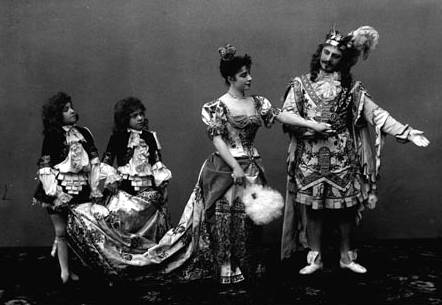
Photo: Carlotta Brianza and Paul Gerdt in the 1890 production of the Sleeping Beauty by the Mariinsky Theatre


Sleeping Beauty Trivia
  • Music composed by Tchaikovsky, and choreographed by Marius Petipa2
  • The premiere performance took place at the Mariinsky Theatre in St. Petersburg, Russia in 1890. The work is widely regarded as Tchaikovsky's finest ballet score, and has become one of the classical repertoire's most famous ballets.2
  • Tchaikovsky's three ballet scores include Sleeping Beauty, Swan Lake and The Nutcracker.2
  • Sleeping Beauty, or La Belle au Bois Dormant, is based upon the classic fairy tale from 1697 by Charles Perrault, Contes de ma Mère l'Oye ("Tales of Mother Goose")2
  • Aurora is one of the greatest and most challenging female roles, as it demands tremendous athletic ability as well as extremely clean technique.1 
  • At the wedding, many other fairytale characters appear as wedding guests - Puss in Boots,  the White Cat, Little Red Riding Hood and the Wolf, and even Cinderella.2

References:
1. http://dance.about.com/od/reviewsandrecommendation1/a/Sleeping_Beauty.htm
2. http://en.wikipedia.org/wiki/The_Sleeping_Beauty_%28ballet%29