Showing posts with label New York City Ballet. Show all posts
Sunday, January 9, 2011
How to Teach a Pirouette
I loved finding this article and video at Dance Teacher magazine on how to teach pirouettes because it is definitely one of the most important skills a dancer needs to master. Here, former New York City Ballet soloist, Katrina Killian, shows just how to teach a Balanchine pirouette, which includes a straight back leg and all weight on the supporting front leg. For more details than the video provides, read the accompanying article: "Technique: Katrina Killian: How I Teach a Pirouette".
Video: http://dancemedia.com/v/4648
Monday, January 3, 2011
Jazz/Contemporary Warm-Up
I've been looking for new elements to include in my contemporary and jazz class warm-ups and came across this video that Dance Teacher Magazine featured back in September 2010 Technique: Shelia Barket: How I teach a warm-up. It's Shelia Barker's, a Broadway Dance Center teacher, jazz dance warm-up and includes some yoga-like poses (downward dog, squat) and is very relaxing. I know my students will love how it warms up the torso and back and helps all those muscles relax and prepare for technique.
Thursday, December 2, 2010
Black Swan - Training Portman to look like a Ballerina
With the premiere of "Black Swan" in movie theaters yesterday, it's exciting to read about the behind-the-scenes making of the movie. The New York Times ran an article on November 26 about how lead actresses Natalie Portman and Mila Kunis trained to look and move like ballerinas. Natalie started intense ballet training a year before filming began, but ABT soloist, Sarah Lane, serves as her body double for the intense (real) dancing scenes. Check it out!
TEN years of serious training and then five more toiling in the ranks. That’s how many years of dedicated study it takes on average to become a principal ballerina at a top company. But Hollywood isn’t willing to wait. So when several actresses signed up to portray professional dancers in new movies, they had to play a very intense game of catch-up.
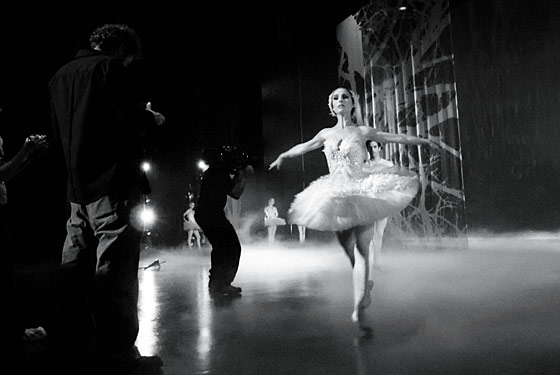
Ms. Portman performs with Benjamin Millepied, the choreographer and New York City Ballet principal.
Actors have impersonated dancers before to varying degrees of success. (See Jessica Alba’s laborious hip-hop moves in “Honey” and Neve Campbell’s elegant arabesques in “The Company” to get a sense of the range.) And some directors, like Bruce Beresford with his recent “Mao’s Last Dancer,” have bypassed actors altogether and cast dancers to achieve authenticity. When a single awkward move can change the tone of an entire scene, portraying a dancer is a serious challenge.
“It’s not the same as Mickey becoming a wrestler because that’s a craft you can learn in a few months,” the directorDarren Aronofsky said, referring to Mickey Rourke, who starred in his film “The Wrestler.” “Ballet is something you have to be trained from a tiny age.”
Mr. Aronofsky’s latest movie, a rumored Oscar contender, “Black Swan,” due Dec. 3, is a psychological thriller centered on a fictional ballet company’s new version of “Swan Lake.” Natalie Portman plays the lead ballerina, andMila Kunis is her rival. In George Nolfi’s “Adjustment Bureau,” out in March, Emily Blunt stars as a member of a real troupe, Cedar Lake Contemporary Ballet.
“At the beginning it was a big question because we didn’t know if any actor could pull it off,” Mr. Aronofsky said of the role of Nina, who turns into the Swan Queen onstage.
When Ms. Portman, 29, took the part, she said, “I really thought I was better than I was.” She wasn’t completely new to ballet, having studied as a child, but at 13 she had traded in her slippers to act.
“It was a rude awakening to get there, and to be, like, I don’t know what I’m doing,” Ms. Portman said by phone, “If I had known how not close to ready I was, I never would have tried it. I’m glad I was a little ignorant slash arrogant.”
Ms. Kunis, 27, described her experience as “ballet on crack.” At the end of her training, which includes three months of daily ballet practice, she said, she had probably lost 20 pounds. “For me it was kind of like: How do you fake it?”
In the film Nina goes through a metamorphosis onstage, from sweet swan to thrashing, rabid, seething one, complete with feathers. Ms. Portman went through a kind of transformation as well. Before she could even tackle the choreography she had to prepare her body, starting more than a year in advance with Mary Helen Bowers, a former City Ballet dancer from North Carolina.
“The idea was, if you were going to look and move like a professional ballerina, you have to train like one, and professional ballerinas dance for 10 to 12 hours a day, six days a week, for years and years on end,” Ms. Bowers said. “So the idea with Natalie was, we have to get you as close to that mark as possible for as many months as possible leading up to the film.”
Ms. Bowers combined basic ballet technique and exercises to make Ms. Portman’s physique more like a dancer’s, with the sinewy, lean muscles, upright carriage, pressed-down shoulders and tell-tale elongated neck.
“There are such physical markers for ballet dancers,” Ms. Bowers said, “we thought that was as important as being able to move.”
Wherever Ms. Portman’s career took her, she trained at least five hours a day with Ms. Bowers, practicing chaînés turns in Bridgehampton or rond de jambes in Belfast. They often started at 5 a.m. and fit in barre exercises and workouts while Ms. Portman filmed other movies.
Ms. Bowers was part of an all-star crew of experts who helped to get the dancing right. The veteran dancers and teachers included Kurt Froman, Jock Soto and Marina Stavitskaya, the ballet mistress Olga Kostritzky and the beloved coach Georgina Parkinson, who died in December. They offered corrections to the actresses during shooting and told Mr. Aronofsky when movement looked false. Dancers, mostly from the Pennsylvania Ballet, performed as the fictional corps and also gave advice to Ms. Portman.
This level of attention was crucial, Ms. Portman said: “I think there is a credibility that lets you get lost in the story when you feel that all the details are right.”
Perfecting something as seemingly simple as the undulating swan arms was one of Ms. Portman’s greatest struggles. “The fluidity, trying to get those hands to move and the arms all the way to her fingers” was tough," Mr. Millepied said. She practiced for hours and watched YouTube clips of famous swan queens like Alicia Alonso and Natalia Makarova to master the move.
Even with all the preparation Ms. Parkinson helped adjust the choreography for the particular quirks of Ms. Portman’s body. “I have short arms,” Ms. Portman said. “She was just, like: ‘You don’t bend arms when you put your arms up. They’re straight. You don’t bend them.’ If I ever bent my elbows she’d be, like, ‘Straight arms, straight arms.’ ” Another challenge was getting Ms. Portman on point. “We would spend 30 minutes a day doing foot exercises,” Ms. Bowers said.
During shooting the process intensified, with Ms. Portman doing short barre exercises five to six times a day to warm up between takes. “I think my body was kind of in emergency mode,” Ms. Portman. “I’m not eating enough, I’m not getting enough sleep. I’m in complete physical distress.” Among the injuries Ms. Portman suffered, the worst was a dislocated rib. To keep going, the lifts were adjusted.
The physical extremes of the art form though were what most interested Ms. Portman and Mr. Aronofsky. “The contrast between what you see onstage and what is underneath is part of the resonance of this film,” Ms. Portman said. “That it’s supposed to look easy and painless and carefree and light and delicate and just pretty, and underneath it’s, like, really gruesome.”
Ms. Bowers recalled, for instance, when Mr. Aronofsky consulted her on the believability of a prosthetic toe. “He was, like, ‘Is this what your toe looks like when your toenail falls off?’ and I was, like, ‘Well maybe we should take a little more off.’ ” She added, “Actually when your toenail falls off, you’re kind of happy, because it’s not a stress fracture.”
Ms. Portman’s experience gave her a taste not only of the physical sacrifices, but also the mental ones. “It was very religious in my mind,” she said. “The ritual of, like, breaking in your point shoes and getting them soft, all of that, it’s almost like tefillin wrapping in Judaism, this thing you do every day, this ritual.”
Photo by Niko Tavernise
Ms. Portman performs with Benjamin Millepied, the choreographer and New York City Ballet principal.
By Julie Bloom
Ms. Portman performs with Benjamin Millepied, the choreographer and New York City Ballet principal.
Actors have impersonated dancers before to varying degrees of success. (See Jessica Alba’s laborious hip-hop moves in “Honey” and Neve Campbell’s elegant arabesques in “The Company” to get a sense of the range.) And some directors, like Bruce Beresford with his recent “Mao’s Last Dancer,” have bypassed actors altogether and cast dancers to achieve authenticity. When a single awkward move can change the tone of an entire scene, portraying a dancer is a serious challenge.
“It’s not the same as Mickey becoming a wrestler because that’s a craft you can learn in a few months,” the directorDarren Aronofsky said, referring to Mickey Rourke, who starred in his film “The Wrestler.” “Ballet is something you have to be trained from a tiny age.”
Mr. Aronofsky’s latest movie, a rumored Oscar contender, “Black Swan,” due Dec. 3, is a psychological thriller centered on a fictional ballet company’s new version of “Swan Lake.” Natalie Portman plays the lead ballerina, andMila Kunis is her rival. In George Nolfi’s “Adjustment Bureau,” out in March, Emily Blunt stars as a member of a real troupe, Cedar Lake Contemporary Ballet.
“At the beginning it was a big question because we didn’t know if any actor could pull it off,” Mr. Aronofsky said of the role of Nina, who turns into the Swan Queen onstage.
When Ms. Portman, 29, took the part, she said, “I really thought I was better than I was.” She wasn’t completely new to ballet, having studied as a child, but at 13 she had traded in her slippers to act.
Photo by Niko Tavernise
Ms. Kunis, 27, described her experience as “ballet on crack.” At the end of her training, which includes three months of daily ballet practice, she said, she had probably lost 20 pounds. “For me it was kind of like: How do you fake it?”
The effort to avoid that consumed Ms. Portman. In the film she performs choreography byBenjamin Millepied, the New York City Ballet principal with a side career as a choreographer, and Ms. Portman does indeed dance, about 10 sequences, with a lot of work for her upper body. The difficult point work and turns were performed by a body double, Sarah Lane, the American Ballet Theater soloist.
In the film Nina goes through a metamorphosis onstage, from sweet swan to thrashing, rabid, seething one, complete with feathers. Ms. Portman went through a kind of transformation as well. Before she could even tackle the choreography she had to prepare her body, starting more than a year in advance with Mary Helen Bowers, a former City Ballet dancer from North Carolina.
“The idea was, if you were going to look and move like a professional ballerina, you have to train like one, and professional ballerinas dance for 10 to 12 hours a day, six days a week, for years and years on end,” Ms. Bowers said. “So the idea with Natalie was, we have to get you as close to that mark as possible for as many months as possible leading up to the film.”
Ms. Bowers combined basic ballet technique and exercises to make Ms. Portman’s physique more like a dancer’s, with the sinewy, lean muscles, upright carriage, pressed-down shoulders and tell-tale elongated neck.
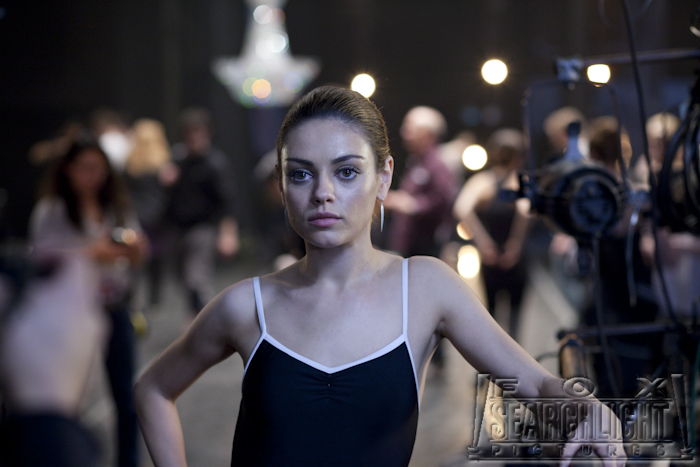
Natalie Portman on the set of Black Swan.
(Photo: Ray Lewis)
“There are such physical markers for ballet dancers,” Ms. Bowers said, “we thought that was as important as being able to move.”
Wherever Ms. Portman’s career took her, she trained at least five hours a day with Ms. Bowers, practicing chaînés turns in Bridgehampton or rond de jambes in Belfast. They often started at 5 a.m. and fit in barre exercises and workouts while Ms. Portman filmed other movies.
Ms. Bowers was part of an all-star crew of experts who helped to get the dancing right. The veteran dancers and teachers included Kurt Froman, Jock Soto and Marina Stavitskaya, the ballet mistress Olga Kostritzky and the beloved coach Georgina Parkinson, who died in December. They offered corrections to the actresses during shooting and told Mr. Aronofsky when movement looked false. Dancers, mostly from the Pennsylvania Ballet, performed as the fictional corps and also gave advice to Ms. Portman.
This level of attention was crucial, Ms. Portman said: “I think there is a credibility that lets you get lost in the story when you feel that all the details are right.”
For Mr. Millepied, who is also Ms. Portman’s off-screen beau, the challenge started with creating a fresh twist on the classic “Swan Lake” vocabulary. (Die-hards will notice changes to the four little swans variation in particular.) But he also had to tailor the choreography so that Ms. Portman looked believable. With both actresses he wanted, he said, to “use their qualities and avoid their weaknesses.”
Perfecting something as seemingly simple as the undulating swan arms was one of Ms. Portman’s greatest struggles. “The fluidity, trying to get those hands to move and the arms all the way to her fingers” was tough," Mr. Millepied said. She practiced for hours and watched YouTube clips of famous swan queens like Alicia Alonso and Natalia Makarova to master the move.
Even with all the preparation Ms. Parkinson helped adjust the choreography for the particular quirks of Ms. Portman’s body. “I have short arms,” Ms. Portman said. “She was just, like: ‘You don’t bend arms when you put your arms up. They’re straight. You don’t bend them.’ If I ever bent my elbows she’d be, like, ‘Straight arms, straight arms.’ ” Another challenge was getting Ms. Portman on point. “We would spend 30 minutes a day doing foot exercises,” Ms. Bowers said.
During shooting the process intensified, with Ms. Portman doing short barre exercises five to six times a day to warm up between takes. “I think my body was kind of in emergency mode,” Ms. Portman. “I’m not eating enough, I’m not getting enough sleep. I’m in complete physical distress.” Among the injuries Ms. Portman suffered, the worst was a dislocated rib. To keep going, the lifts were adjusted.
The physical extremes of the art form though were what most interested Ms. Portman and Mr. Aronofsky. “The contrast between what you see onstage and what is underneath is part of the resonance of this film,” Ms. Portman said. “That it’s supposed to look easy and painless and carefree and light and delicate and just pretty, and underneath it’s, like, really gruesome.”
Ms. Bowers recalled, for instance, when Mr. Aronofsky consulted her on the believability of a prosthetic toe. “He was, like, ‘Is this what your toe looks like when your toenail falls off?’ and I was, like, ‘Well maybe we should take a little more off.’ ” She added, “Actually when your toenail falls off, you’re kind of happy, because it’s not a stress fracture.”
Ms. Portman’s experience gave her a taste not only of the physical sacrifices, but also the mental ones. “It was very religious in my mind,” she said. “The ritual of, like, breaking in your point shoes and getting them soft, all of that, it’s almost like tefillin wrapping in Judaism, this thing you do every day, this ritual.”
Monday, November 8, 2010
Visions of Sugar Plums Danced in Their Heads
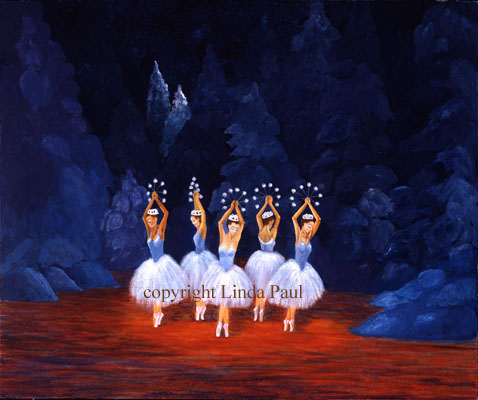
Painting from the Nutcracker by Linda Paul
Got a few extra minutes to get into the Nutcracker and holiday spirit? Sit back and enjoy some excerpts and interviews from some of the world's greatest ballet companies and their Nutcracker performances. Many big ballet companies have their own YouTube channels. Search for them and watch clip after clip of not only performances, but interviews and rehearsals.
Miami City Ballet has quite a few back-stage interviews done by the company members themselves, so it really gives viewers a relaxed and real inside-look into the company.
Here's Patricia Delgado interviewing her sister, Jeanette, who is the Dewdrop.
And here is Patricia Delgado's Nutcracker journal, where she tapes rehearsals and interviews the dancers about their parts in the show.
And an interview with retiring ballet dancer, Deanna Seay, who dances the Sugar Plum Fairy.
New York City Ballet's Channel: http://www.youtube.com/user/newyorkcityballet
Pacific Northwest Ballet's Channel: http://www.youtube.com/user/pacificnwballet
Joffrey Ballet's Channel: http://www.youtube.com/user/TheJoffreyBallet
Houston Ballet's Channel: http://www.youtube.com/user/houstonballet
San Fransisco Ballet's Channel: http://www.youtube.com/user/SFBallet
Annaheim Ballet's Channel: http://www.youtube.com/user/AnaheimBallet
Thursday, July 1, 2010
Advice: Establishing Authority as a Young Teacher
This article from Dance Teacher Magazine offers some excellent advice on how young teachers can still be respected by students who are close to their age. Advice like establish boundries by staying professional, always come prepared, keep a watchful eye on the students by giving them corrections, get more education, and keep your cool when you make a mistake.
You can be professional by being "approchable, but not friendly," the article reads. Also, be cautious outside of the classroom as well by declining invitations to social events with your students or social networking online.
Coming to class prepared cannot be stressed enough. Knowing the combinations you're going to give and having music prepared will boost your own confidence, which will also boost your authority.
The article also stresses the importance of keeping yourself educated by attending workshops, going back to school, and getting educated on anatomy and the science of the body. One well-respected dance teacher certification program that only requires one week a year is Dance Master's of America.
To read the original article, "Theory and Practice: Become an Authority,"click here.
You can be professional by being "approchable, but not friendly," the article reads. Also, be cautious outside of the classroom as well by declining invitations to social events with your students or social networking online.
Coming to class prepared cannot be stressed enough. Knowing the combinations you're going to give and having music prepared will boost your own confidence, which will also boost your authority.
The article also stresses the importance of keeping yourself educated by attending workshops, going back to school, and getting educated on anatomy and the science of the body. One well-respected dance teacher certification program that only requires one week a year is Dance Master's of America.
To read the original article, "Theory and Practice: Become an Authority,"click here.
Daniel Ulbricht, NYCB principal, teaching a class at the Rock School
Tuesday, May 25, 2010
American Ballet Theater Turns 70
Julie Kent and Jose Manuel Carreño in Apollo. Photo courtesy of Marty Sohl
American Ballet Theater is celebrating it's 70th birthday this month, and held a gala at the Metropolitan Opera House to showcase it's spring repertoire (see pictures from the gala here). (Read the NY Times article about the gala, from a rather sarcastic and entertaining perspective.) ABT is one of the world's leading ballet companies, along with New York City Ballet and San Fransisco Ballet, according to the London Observer. So, what makes it so special? Here is a brief history of the company, facts every Dance Nerd should know!
ABT Trivia
- Founded in 1937 and named Mordkin Ballet
- Reorganized and renamed in 1940, Ballet Theater, with the aim "to develop a repertoire of the best ballets from the past and to encourage the creation of new works by gifted young choreographers."(from http://www.abt.org/insideabt/history.asp)
- It's current name wasn't given until 1956
- They have brought all the finest full-length ballets from the 19th and 20th centuries to the stage; ballets such as Swan Lake, Giselle, and Sleeping Beauty, Apollo, Les Sylphides, Airs, and Push Comes to Shove.
- In 1960, they became the first American ballet company to perform in the Soviet Union
- They perform at the Metropolitan Opera House in New York City and are also based in New York City
Famous ABT Dancers
- Ivan Allen
- Alicia Alonso
- Nina Ananiashvili
- Mikhail Baryshnikov
- Patrick Bissell
- Julio Bocca
- Gabrielle Brown
- Leslie Browne
- Erik Bruhn
- Fernando Bujones
- Anton Dolin
- Alessandra Ferri
- Alexander Filipov
- Alexander Godunov
- Cynthia Gregory
- Cynthia Harvey
- Melissa Hayden
- Susan Jaffe
- Gelsey Kirkland
- Robert La Fosse
- Charles Maple
- Natalia Makarova
- Vladimir Malakhov
- Dame Alicia Markova
- Kevin McKenzie
- Amanda McKerrow
- Kirk Peterson
- Danilo Radojevic
- Johan Renvall
- Keith Roberts
- Amy Rose
- Christine Sarry
- Marianna Tcherkassky
- Antony Tudor
- Martine van Hamel
Artistic Directors
- Lucia Chase and Oliver Smith (1940-1980)
- Mikhail Baryshnikov (1980-1989)
- Jane Hermann and Oliver Smith (1989-1992)
- Kevin McKenzie (1992-present)
Tuesday, May 11, 2010
New York City Ballet Workout
The New York City Ballet workout used to only be a book, then it was a DVD, and now it's available on YouTube for FREE! I always wanted to buy the book, but was too cheap, so I held off. Now that it's on YouTube, I've been doing the workout at home and was surprised by how much it got my heart rate up and felt like a great workout. I also taught it to my dancers in their ballet class - they liked it and were sweating, red-faced, and out of breath. For a teacher, that's success!
Here it starts with Part 1. There are 9 parts in all, and seems to be over an hour. Quite long, but I do the first couple of parts to get some cardio, stretch, and do abs. The voice-over is rather strange, but it makes it feel like you're in a ballet master class. See what you think!
Thursday, May 6, 2010
Top Ten Ballets - Romeo and Juliet
Here is the most famous scene from the ballet, with London's Royal Ballet greatest, Rudolph Nureyev and Margot Fonteyn. After this performance, their partnership became famous.
Plot[Excerpt from dance.about.com] The ballet begins with feuding between the Capulets and the Montagues. Wearing a disguise, Romeo Montague crashes a party at the Capulet house, where he meets Juliet Capulet. He falls instantly in love with her. The two secretly proclaim their eternal love for each other, on the balcony.
Hoping to finally put an end to the family feud, Friar Laurence secretly marries the couple. But the feuding continues: Juliet's cousin Tybalt kills Romeo's friend Mercutio during a fight. A distraught Romeo kills Tybalt in a fit of revenge, and is sent into exile.
Juliet turns to Friar Laurence for help, so he devises a plan to help her. Juliet is to drink a sleeping potion to make her appear dead. Her family will then bury her. Friar Laurence will then tell Romeo the truth; he will rescue her from her tomb and take her away, where they will live together happily ever after.
That night, Juliet drinks the potion. When her distraught family finds her dead the next morning, they proceed to bury her. The news of Juliet's death reaches Romeo, and he returns home desperately grieving. (He never received the message from Friar Laurence.) Believing that Juliet is really dead, he drinks poison. When Juliet awakens, she sees that Romeo is dead and stabs herself.
Romeo and Juliet Trivia
- Even though Shakespeare wrote Romeo and Juliet back in the late 1500's, the ballet was not created until 1938!
- Sergei Prokiev composed the score in 1935, after being commissioned by the Russian Kirov Ballet, but the full-length ballet was not presented until 1938 in Brno, Czechoslovakia. However, it is better known today from the significantly revised version that was first presented at the Kirov in Leningrad in 1940, with choreography by Leonid Lavrovsky.
- The ballet did not premier in America until 1969, when it was performed by the Stuttgart Ballet. The first American ballet company to do the ballet was the Joffrey Ballet in 1984.
- Here is a brief timeline of the ballet's most famous performances:
- 1962 - Stuttgart Ballet (Germany), choreographed by John Cranko
- 1965 - Royal Ballet in London, choreographed by Sir Kenneth MacMillan. Margot Fonteyn and Rudolph Nureyev brought new life to the characters.
- 1985 - Hungarian National Ballet, choreographed by László Seregi in Budapest
- 1984-85 - Joffrey Ballet was the first American ballet company to perform the ballet
- 2007 - New York City Ballet, restaged by Peter Martins to the Prokofiev music
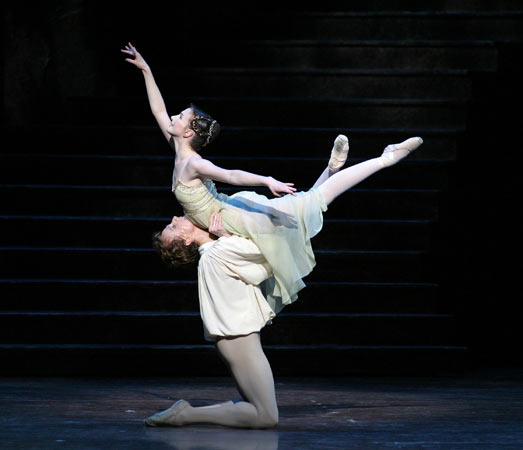
Lauren Cuthbertson as Juliet dances with Edward Watson as Romeo, of the Royal Ballet in 2006 Photograph: Dee Conway
[All trivia taken from wikipedia.org]
Friday, April 30, 2010
Top Ten Ballets - Coppélia
Here is Swanhilda's variation, while she's standing outside Dr. Coppélius' house, looking at the life-like Coppélia, with whom her fiancé is infatuated.
Plot
The story of Coppélia is a about a life-like doll; her creator, Doctor Coppélius; a man named Franz who is infatuated with Coppélia; and his fiancé, Swanhilda. Coppélia is so lifelike that Franz, a village swain (or redneck in today's society!), is infatuated with her, and sets her aside his true heart's desire, even though he is engaged to Swanhilda. Swanhilda becomes very jealous of Coppélia, not knowing she is just a doll. So, she and her girlfriends sneak into Dr. Coppélius' house to meet Coppélia. There they find a room full of mechanical, life-size dolls, and discover that Coppélia is just a doll.
In Act II, just as they are about to leave, Dr. Coppélius returns to his house, and Swanhilda quickly hides behind a curtain. Then, Franz arrives at the doctor's house to meet Coppélia. The doctor gets an idea, thinking he could kill Franz and use his life to make Coppélia come to life and no longer be a lonely bachelor. He offers Franz a drink, in which he has put a sleeping powder, and Franz falls asleep. Meanwhile, Swanhilda is changing into Coppélia's clothes and comes out of the closet, pretending to be the doll to show Franz his folly and to rescue him from the crazy doctor. Seeing Swanhilda dressed as Coppélia, Dr. Coppélius believes his magic has worked! However, Swanhilda awakens Franz and shows him Coppélia is just a doll.
Finally the two are married, but Dr. Coppélius interrupts, demanding compensation for the damage Swanilda caused. She offers her dowry, but her father intercedes to pay. The village joins Franz and Swanilda in celebrating their wedding. Even Dr. Coppélius can share their joy!
Coppélia Trivia
- Originally choreographed by Arthur Saint-Léon. Restaged by George Balanchine in 1974 for the New York City Ballet.
- First performed in 1870 at the Théâtre Impérial de l´Opéra, with Giuseppina Bozzacchi in the principal role of Swanhilde, in Paris, France.
- It eventually it became the most-performed ballet at the Opera Garnier in Paris.
- It is of the romantic ballet genre, and is also a comic ballet, unlike the tragic ballet of Giselle
- (Excerpt taken from balletmet.org) Coppélia is probably the best-known comedy ballet, and certainly it's the most often performed - but it's much more than just a funny piece. The premiere was attended by the leading figures of Parisian society. A breakaway from the sad, Romantic ballets of the day, Coppélia was an immediate success with its humor, vigorous national dances and brightness. It was created at a time when Paris was slipping from its position as the dance capital of the world, and the popularity of ballet was declining. Coppélia was the last hoorah for the Paris Opéra before it fell into decay.
Elisa Celis and Garry Avis in Ronald Hynd's production of Coppelia for English National Ballet
© Daria Klimentova
© Daria Klimentova
Wednesday, April 28, 2010
Test Your Ballet Knowledge
I found what I thought was a easy, little ballet quiz on dance.com. But to my surprise, the questions were not terribly easy! Take the quiz and see how well you do, then Google the things you didn't know. Thankfully, I knew that croisé devant is a position of the legs, that fouetté means whipped, and that Serenade is not a ballet of the Romantic era (remember - it's a Balanchine ballet).
Here are some things you may not know...
What was Lincoln Kirstein's relationship to New York City Ballet?
Have a guess yet? He was a writer, art connoiseur, and cultural figure in NYC who then became the Managing Director of the Ballet.
Which composer worked most closely with Sergei Diaghilev and the Ballets Russes?
I guessed Igor Stravinsky, just because he's the one of the most well-known ballet composers, and got lucky, because it was right!
Where did the Vaganova method originate?
If you guessed Russia, you are correct! It was started by a woman named Agrippina Vaganova.
Choreographer William Forsythe is celebrated for which style of ballet?
Contemporary. He is quite a prolific choreographer and is still living today.
Here are some things you may not know...
What was Lincoln Kirstein's relationship to New York City Ballet?
Have a guess yet? He was a writer, art connoiseur, and cultural figure in NYC who then became the Managing Director of the Ballet.
Which composer worked most closely with Sergei Diaghilev and the Ballets Russes?
I guessed Igor Stravinsky, just because he's the one of the most well-known ballet composers, and got lucky, because it was right!
Where did the Vaganova method originate?
If you guessed Russia, you are correct! It was started by a woman named Agrippina Vaganova.
Choreographer William Forsythe is celebrated for which style of ballet?
Contemporary. He is quite a prolific choreographer and is still living today.
Saturday, February 13, 2010
Behind the Scenes - NYCB's Romeo and Juliet
With Valentine's Day upon us, it is only fitting to include a post about Romeo and Juliet! Here's a video where we see a different twist on the famous ballet - behind the scenes with New York City Ballet. It is an entire series, but I've chosen one episode where the dancers talk about dancing the lead roles. Enjoy!
Watch the video: http://www.youtube.com/watch?v=VaIp_owf7ts
Subscribe to:
Posts (Atom)