
Here is a beautiful example of how Alina Cojocaru's arms and head are just as important as the difficult Pointe work she does with her feet and legs. Her hard work and effort is not reflected in her upper body, which is the trick to making something difficult look easy. The arms finish the movement and give it artistry.
With so much focus on legs, extension, pointed feet, the back and core, it's easy to forget about our arms. Yet, arms are the icing on the cake, they complete the package of a dancer, and start and finish every movement. They tell the story, show the character, and can either add gracefulness and poise, or awkwardness and stiffness.
In this article from Dance Magazine (April 2010), writer Lauren Kay offers advice from professionals on how to break bad habits with your arms to get the grace and artistry you need to take your dancing to the next level. (here's my skinny version)
Arms can be the ultimate signature of a dancer’s artistry. “How a dancer uses the arms has a profound influence on the quality of movement,” says Carinne Binda, co-artistic director of Sacramento Ballet. “And it’s a true sign of artistic maturity. If you haven’t made the choice of engaging the arms expressively, the dance looks static.” Dance Magazine spoke with Binda, as well as Nan Giordano, artistic director of Giordano Jazz Dance Chicago, and Megan Richardson, physical therapist at Harkness Center for Dance Injuries, for advice on using the arms expressively—and with strength.
HABIT: Droopy arms A wilted port de bras is no way to captivate an audience. According to Richardson, “The tendency toward droopy arms happens when a dancer tries to hold a long, heavy arm without support from the back and scapula.” She adds that this habit also arises from trying to appear graceful or soft. Binda agrees: “There is a lot of confusion between being soft and being weak. They aren’t the same thing.”
BREAK IT: “Instead of engaging the small arm muscles, which can’t hold the arm up themselves,” says Richardson, “use the larger back muscles—especially the lower and mid-trapezoids. Think of pulling each scapula in and down toward your opposite back pocket, forming an ‘X’ of support across the back.” Binda notes that in warm-up, the upper body deserves as much attention as the legs. “At the barre, even in pliés, do different port de bras and plenty of cambrés to get the arms ready to dance.” Giordano suggests imagining the arms moving through water to give them a strong, pliable energy.
HABIT: Not engaging the back Without a connection to the back and core, arms can look not only droopy but also disjointed, as if stuck onto a mannequin. Balancing arm movement with core and back strength is essential for freedom of movement in the arm itself. Think of the arm as a lever: The farther it reaches from its origin (your core and trunk), the more strength and connection to that origin is required.
BREAK IT: Richardson believes that the first step to engaging the back is understanding the physics of the body. “The arms are attached to the spine through the scapula and clavicle. They come from the back anatomically. The arms, core, and spine deeply affect each other; the relationship goes both ways.”
Giordano suggests this exercise for sensing the arm/back connection: Stand in front of a partner. One partner tries to keep their arms in “long jazz arm” position—“a classical rounded second, with elbows facing back and palms facing the floor”—while the other presses down on the forearms. “This helps you find your back and center,” she says, “and a feeling of resistance and power in the arms.”
Binda sees integrating the arms with the back as a matter of making firm artistic choices: “Consciously choose how you use your arms as part of the whole-body movement. Do you want your arm to finish or lead the movement? Do you want the motion to be lyrical or sharp? Considering these things will help you connect your arm to your back and core, where all movement starts.”
HABIT: Tense, brittle arms In contrast to droopy arms, some performers battle stiff arms accented by tense hands. Binda says this tension can come from holding the breath or isolating the arm, “thinking of it as a separate, rigid fixture, instead of connected to the entire movement.”
BREAK IT: “Think of the air and movement of the arms as you dance, instead of bones and muscle,” Binda suggests. “Tense arms are counterproductive! You aren’t launching a 747 jet, even when you jump.” Richardson adds that moderate weight-lifting can enhance stability in the shoulder, which diffuses tension in the arms. “With control from the shoulder and back, the arm can be loose, fluid and articulate,” she says. “But if you think of holding your arm up with your arm, there is tension that can’t be escaped.”
Thursday, May 6, 2010

Top Ten Ballets - Romeo and Juliet
Here is the most famous scene from the ballet, with London's Royal Ballet greatest, Rudolph Nureyev and Margot Fonteyn. After this performance, their partnership became famous.
Plot[Excerpt from dance.about.com] The ballet begins with feuding between the Capulets and the Montagues. Wearing a disguise, Romeo Montague crashes a party at the Capulet house, where he meets Juliet Capulet. He falls instantly in love with her. The two secretly proclaim their eternal love for each other, on the balcony.
Hoping to finally put an end to the family feud, Friar Laurence secretly marries the couple. But the feuding continues: Juliet's cousin Tybalt kills Romeo's friend Mercutio during a fight. A distraught Romeo kills Tybalt in a fit of revenge, and is sent into exile.
Juliet turns to Friar Laurence for help, so he devises a plan to help her. Juliet is to drink a sleeping potion to make her appear dead. Her family will then bury her. Friar Laurence will then tell Romeo the truth; he will rescue her from her tomb and take her away, where they will live together happily ever after.
That night, Juliet drinks the potion. When her distraught family finds her dead the next morning, they proceed to bury her. The news of Juliet's death reaches Romeo, and he returns home desperately grieving. (He never received the message from Friar Laurence.) Believing that Juliet is really dead, he drinks poison. When Juliet awakens, she sees that Romeo is dead and stabs herself.
Romeo and Juliet Trivia
- Even though Shakespeare wrote Romeo and Juliet back in the late 1500's, the ballet was not created until 1938!
- Sergei Prokiev composed the score in 1935, after being commissioned by the Russian Kirov Ballet, but the full-length ballet was not presented until 1938 in Brno, Czechoslovakia. However, it is better known today from the significantly revised version that was first presented at the Kirov in Leningrad in 1940, with choreography by Leonid Lavrovsky.
- The ballet did not premier in America until 1969, when it was performed by the Stuttgart Ballet. The first American ballet company to do the ballet was the Joffrey Ballet in 1984.
- Here is a brief timeline of the ballet's most famous performances:
- 1962 - Stuttgart Ballet (Germany), choreographed by John Cranko
- 1965 - Royal Ballet in London, choreographed by Sir Kenneth MacMillan. Margot Fonteyn and Rudolph Nureyev brought new life to the characters.
- 1985 - Hungarian National Ballet, choreographed by László Seregi in Budapest
- 1984-85 - Joffrey Ballet was the first American ballet company to perform the ballet
- 2007 - New York City Ballet, restaged by Peter Martins to the Prokofiev music
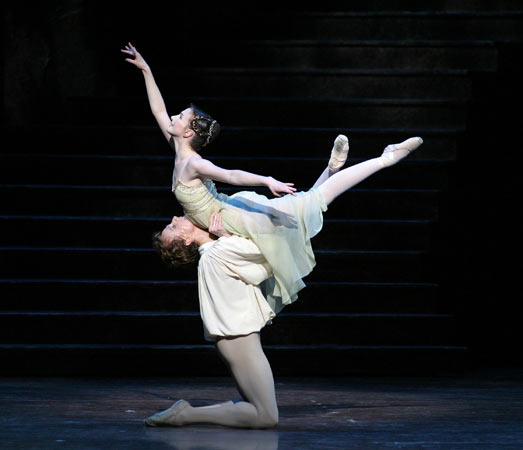
Lauren Cuthbertson as Juliet dances with Edward Watson as Romeo, of the Royal Ballet in 2006 Photograph: Dee Conway
[All trivia taken from wikipedia.org]
Wednesday, May 5, 2010
Top Ten Ballets - The Nutcracker
Here is the Russian Bolshoi Ballet performing the Sugar Plum Fairy and the Grand Pas de Deux. This is my favorite version of the Sugar Plum Fairy.
Plot
Based on the book, "The Nutcracker and the Mouse King" by E.T.A. Hoffman, this ballet is the most famous and well-loved of all. It takes place in Western Europe in the 1880's, and centers around a little girl named Clara who is given a Nutcracker doll on Christmas Eve. She falls asleep and dreams that the Nutcracker comes to life as a prince. They travel around the world and have adventures in China, India, Russia, and in magical lands where candy abounds.
Nutcracker Trivia
- Composed by Pyotr Tchaikovsky in the 1890's, near the end of his life2
- There is a debate as to who choreographed the ballet - Marius Petipa began the work in 1892, but his assistant of seven years, Lev Ivanov, stepped in to take over when Petipa fell ill. The most famous version, however, was created in 1954 by George Balanchine for the New York City Ballet.1
- Mikail Baryishnikov restaged the ballet in 1976 for the American Ballet Theater and challenged Balanchine's version as the most popular one. Baryshnikov omitted the roles of the Sugar Plum Fairy and Prince Koklyush, and gave their dances to Clara and the Nutcracker. They not only perform the entire pas de deux usually danced by the Fairy and Koklyush, but also take part in the Waltz of the Flowers and the Final Waltz. In addition, although the Mother Ginger and her Clowns music is heard, we never see Mother Ginger herself, only four court jesters who perform the dance.1
- First performed at the Imperial Mariinsky Theatre in St. Petersburg, Russia1
- Hoffman's original story was modified quite a bit in order for the ballet to be suitable for children1
- The 1892 premiere of The Nutcracker failed with both the public and critics. Unfortunately, Tchaikovsky never knew what a huge success the ballet became, as he died less than a year later.2
- Tschaikovsky was asked to use the celesta, a new instrument, to make the music for the Sugar Plum Fairy sound like the "sprays of a fountain."2
- Tschaikovsky based the music for the Arabian Dance on a Georgian lullaby.2
- The Sugar Plum Fairy's dance with the Prince is probably the most famous pas de deux (dance for two) in ballet.2

References:
1. http://en.wikipedia.org/wiki/The_Nutcracker
2. http://dance.about.com/od/adultdancers/p/Nutcracker.htm
3. Photo: New York City Ballet
Tuesday, May 4, 2010
Choreography: If a picture is worth a thousand words, isn't a dance also worth that?
When is a dance considered successful? I went to a student-choreographed performance at a performing arts high school this weekend and found myself wondering which pieces were the "best" and why.
There were several pieces that really stood out - one was about how one person can make a difference, another was an entertaining piece about the circus, another about the concepts of fate and chance, and the last about the relationship between a mother and daughter. I loved the piece about making a difference - there was a dancer in black and two in white and they fought most of the dance to radio bulletin voice-overs from wars and the Civil Rights movement. It ended with quotes from Martin Luther King's "I Have a Dream Speech," then the dancer in black shouted "I am only one, but I can make a difference!" It was powerful, gave me chills, and I felt like I could make a difference afterwards!
I GOT that piece - it was powerful and made sense, unlike many of the other pieces that obviously had a message, but I was lost and confused by the end of the dance. I found myself wondering if the other dances I didn't understand were somehow unsuccessful, or if the choreographer failed to communicate, touch or entertain the audience. The pieces I liked the best, so it seems the rest of the audience did, too, by the loud clapping and cheering that ensued.
I think it goes back to the age-old idea that art is subjective. Maybe the pieces I didn't understand, someone else did. Or, if no one understood (or even liked the choreography) but the choreographer and dancers did understand and were touched or changed in some way by the choreographer's message, then it touched some.
I think sometimes as choreographers, like artists, HAVE to create something to cleanse our minds, vent, or express something very strong within us. And if no one else understands it, but as artists we are purified and strengthened by our work, is it still unsuccessful? I compare it to the modern art many of us look at and think a four-year-old could do, yet, it's worth thousands of dollars. Maybe dance is the same way. Some of it, we just won't understand or feel anything afterwards. As for me, though, I have a very strong desire to connect to my audience. I want them to feel something afterwards, make them think, or simply entertain. But it takes thought, skill, and planning to create a piece that clearly communicates your message.
Because if a picture is worth a thousand words, so is a dance, as it can speak louder and more clearly than words, and people actually listen.
There were several pieces that really stood out - one was about how one person can make a difference, another was an entertaining piece about the circus, another about the concepts of fate and chance, and the last about the relationship between a mother and daughter. I loved the piece about making a difference - there was a dancer in black and two in white and they fought most of the dance to radio bulletin voice-overs from wars and the Civil Rights movement. It ended with quotes from Martin Luther King's "I Have a Dream Speech," then the dancer in black shouted "I am only one, but I can make a difference!" It was powerful, gave me chills, and I felt like I could make a difference afterwards!
I GOT that piece - it was powerful and made sense, unlike many of the other pieces that obviously had a message, but I was lost and confused by the end of the dance. I found myself wondering if the other dances I didn't understand were somehow unsuccessful, or if the choreographer failed to communicate, touch or entertain the audience. The pieces I liked the best, so it seems the rest of the audience did, too, by the loud clapping and cheering that ensued.
I think it goes back to the age-old idea that art is subjective. Maybe the pieces I didn't understand, someone else did. Or, if no one understood (or even liked the choreography) but the choreographer and dancers did understand and were touched or changed in some way by the choreographer's message, then it touched some.
I think sometimes as choreographers, like artists, HAVE to create something to cleanse our minds, vent, or express something very strong within us. And if no one else understands it, but as artists we are purified and strengthened by our work, is it still unsuccessful? I compare it to the modern art many of us look at and think a four-year-old could do, yet, it's worth thousands of dollars. Maybe dance is the same way. Some of it, we just won't understand or feel anything afterwards. As for me, though, I have a very strong desire to connect to my audience. I want them to feel something afterwards, make them think, or simply entertain. But it takes thought, skill, and planning to create a piece that clearly communicates your message.
Because if a picture is worth a thousand words, so is a dance, as it can speak louder and more clearly than words, and people actually listen.
Top Ten Ballets - La Sylphide
La Sylphide danced by the Paris Opera Ballet, with Mathieu Ganio, Aurelie Dupont and the Corps de Ballet. Mathieu reminds me of Baryishnikov, with his ability to fly!
Plot
[Excerpt taken from dance.about.com] On the morning of his wedding day, a Scottish farmer named James falls in love with a vision of a magical sylph, or spirit. An old witch appears before him, predicting that he will betray his fiancee. Although enchanted by the sylph, James disagrees, sending the witch away.
All seems fine as the wedding begins. But as James begins to put the ring on his fiancee's finger, the beautiful sylph suddenly appears and snatches it away from him. James abandons his own wedding, running after her. He chases the sylph into the woods, where he again sees the old witch. She offers James a magical scarf. She tells him that the scarf will bind the sylph's wings, enabling him to catch her for himself. James is so enamored by the sylph that he wishes to catch her and keep her forever.
James decides to take the magical scarf. He wraps it around the sylph's shoulders, but when he does, the Sylph's wings fall off and she dies. James is left all alone, heartbroken. He then watches his fiancee marry his best friend.1
La Sylphide Trivia
- First performed in Paris in 1832
- Originally choreographed by Philippe (or Filippo) Taglioni, who created it for his daughter, Marie Taglioni, who went on to be one of the world's best dancers of her time. The surviving version of this ballet was choreographed by August Bournonville in 1836.1
- Considered the first romantic and longest surviving ballet, or ballet blanc (white ballet) for the scenes where ballerina and female corps de ballet all wear white.2
- Often confused with the ballet Les Sylphides, which is about forest spirits, but the two are completely unrelated.

Photo: Martin Mydtskov Rønne Dancer: Gudrun Bojesen of the Royal Danish Ballet
References:
1. http://dance.about.com/od/reviewsandrecommendation1/a/La_Sylphide.htm
2. http://en.wikipedia.org/wiki/La_Sylphide
Monday, May 3, 2010
Top Ten Ballets - La Bayadère
Nikkya's death scene - Paris Opera Ballet, 1992. Dancer: Isabelle Guerin
Watch the Paris Opera Ballet's Corps de Ballet perform the Kingdom of Shades scene (not able to embed it). You dancers out there will appreciate the extreme difficulty of executing arabesque fondues over and over again for an entire FIVE minutes! Talk about serious lower back cramps! Then, to go from that to perfect formations, gorgeous developpes, and more arabesques. Only the Paris Opera can make it look so perfect and flawless, and these aren't even the Etoiles!
Plot
This ballet, set in 19th century India, has all the makings of a juicy soap opera - an exotic dancer, a warrior, a love triangle, murder, drugs, revenge, ghosts, and true love.
La Bayadère (which means Temple Dancer or Temple Maiden) tells the story of the Bayadère Nikiya and the warrior Solor, who have sworn eternal fidelity to one another. The High Brahmin, or high temple priest, however, is also in love with Nikiya and learns of her relationship with Solor. Moreover, the Rajah Dugmanta of Golconda (or ruler) has selected Solor to be the fiancé of his daughter Gamzatti, and Nikiya, unaware of the arrangement, agrees to dance at the couple's betrothal celebrations.
The jealous High Brahmin—in an effort to have Solor killed and have Nikiya for himself—tells the Rajah that the warrior has already vowed love to the Bayadère over a sacred fire. But the High Brahmin's plan backfires when, rather than becoming angry with Solor, the Rajah vows that Nikiya should be the one who must die. Gamzatti, who has been eavesdropping on this exchange, summons Nikiya to the palace in an attempt to bribe the Bayadère into giving up her beloved. As their rivalry ensues, Nikiya picks up a dagger in a fit of rage and attempts to kill Gamzatti, only to be stopped in the nick of time by Gamzatti's aya (or maid). Nikiya then flees in horror at what she had almost done. As did her father, Gamzatti vows that the Bayadère must die.
At the betrothal celebrations Nikiya performs a somber dance while playing her veena (an Indian musical instrument). She is then given a basket of flowers which she believes are from Solor, and so begins a frenzied and joyous dance. Little does she know that the basket is from the Rajah and Gamzatti, who have concealed beneath the flowers a venomous snake. The Bayadère then holds the basket too close and the serpent charges forth and bites her on the neck. The High Brahmin offers Nikiya an antidote to the poison, but she chooses death rather than life without her beloved Solor.
In the next scene the depressed Solor smokes opium. In his dream-like euphoria he has a vision of Nikiya's shade (or spirit) in a nirvana among the star-lit mountain peaks of the Himalayas called The Kingdom of the Shades. Here, the lovers reconcile among the supreme opulence and order of the shades of other Bayadères (in the original production of 1877 this scene took place in an illuminated enchanted palace in the sky). When Solor awakes, preparations are underway for his wedding to Gamzatti.
In the temple where the wedding is to take place the shade of Nikiya haunts Solor during his dances with Gamzatti. When the High Brahmin joins the couple's hands in marriage, the Gods take revenge for Nikiya's murder by destroying the temple and all of its occupants.
The spirits of both Nikiya and Solor are reunited and spirited off toward the Himalayas.1
La Bayadère Trivia
- Originally performed by the Imperial Ballet at the Imperial Bolshoi Kamenny Theatre in St. Petersburg, Russia in 1877
- Choreographed by the great Marius Petipa to the music of Ludwig Minkus
- La Bayadère is an important connection between the romantic and classical eras of ballet, where the ballerinas wear the shorter classical tutus when doing ballet roles, but there are still many romantic movements and La Bayadère predates the major romantic classics by several years.2
- Bayadère is French for an Indian temple dancer. In Russian it is called Bayaderka, the Russian word for an Indian Temple Dancer.2
- The Kingdom of the Shades, the last scene from the ballet, is one of the most celebrated excerpts in all of classical ballet, and it is often extracted from the full-length work to be performed independently. It is also one of the most difficult men's variations that exist, with very large jumps including cabrioles and a beautiful manege (dancing in a circle) at the end.1
- The Bronze Idol, (also called "Golden Idol" and "Little God"), is an incredibly demanding men's variation. Dressed only in a dance belt and headpiece, the dancer paints his entire body gold for this variation.2
1. http://en.wikipedia.org/wiki/La_Bayadere
2. http://www.the-ballet.com/bayadere.php

Adiarys Almeida of Corella Ballet dances in Natalia Makarova's "La Bayadere"; credit: Rosalie O'Connor/Corella Ballet
Sunday, May 2, 2010
Top Ten Ballets - Giselle
Mikhail Baryishnikov performs Albrecht's variation from Act II with the Willis. Notice how he defies gravity!
Plot
Giselle is set in the Rhineland of France in the middle ages during the grape harvest. The story begins when Giselle falls in love with a nobleman named Albrecht, who has captured the girl’s attention while masquerading as a farmer named Loys. However, Hilarion, a hunter, is also in love with Giselle and warns her against trusting this stranger. When Giselle finds out that Loys is not only a liar, but is a liar with a fiancée, the young peasant girl with a weak heart dances herself to death and becomes one of the Wilis, the virgins who have been cheated out of their marriages by death.
Albrecht, who is still in love with Giselle, visits her grave and she appears as a ghost before him. He asks for her forgiveness, and against the will of the Willis, she grants it to him and disappears again. Hilarion enters the last scene, also to visit Giselle's grave, and then is thrown to his death in a lake by the Willis. The Willis then pursue Albrecht and sentence him to death, but Giselle protects him and her love saves him from the Willis. By not succumbing to feelings of vengeance and hatred that define the Wilis, Giselle is freed from any association with them, and returns to her grave to rest in peace.
Giselle Trivia
- Jean Coralli and Jules Perrot choreographed the original version of Giselle, but the most popular version includes the revisions of Marius Petipa.
- Originally performed in 1841 in Paris, France at the Ballet du Théâtre de l'Académie Royale de Musique
- The ballet was conceived by the influential French poet, author, and critic Théophile Gautier.
- Giselle was created to honor the ballerina Carlotta Grisi, an Italian ballerina, whom Gautier not only admired for her dancing, but with whom he was in love.
- Gautier was inspired by a passage from Heinrich Heine's 1835 poem, De l'Allemagne

© State Ballet of Georgia
Subscribe to:
Posts (Atom)


